
Dreams on a Big Screen – A DIY Home Theater Journey…
Hello friends, I’m Samrat, born in Kolkata the City of Joy, brought up in the green, vibrant IIT Kharagpur campus of West Bengal.
Being the son of an electrical engineer, I was surrounded by circuits, tools, and gadgets from a very young age.
While other kids loved cricket, I was often busy tinkering with wires and speakers. With time, my fondness for electronics transformed into a passion – and eventually into what some of my friends now call ‘madness’ – the world of home audio systems.
Back in late 2014 and early 2015, I set myself a dream project: to build my own DIY home theater room.
Not just any home theater, but one that would combine affordability with value, using powerful gadgets and quality materials without giving in to the lure of overpriced high-end brands.
My goal was simple – make it budget friendly, yet create an experience so immersive that every movie lover would envy it.
Why a Home Theater?
For movie lovers like me, a home theater is more than just a room. It’s a sanctuary where you can escape into stories, feel the roar of a jet engine, or sense the whisper of a dialogue as if the character were standing next to you.
Instead of paying thousands at multiplexes, imagine enjoying the same (or even better) cinematic experience from the comfort of your recliner, with popcorn at half the price!
Let’s expand my 15 FAQs which has initially came into my mind initially..
FAQs on Home Theaters
1. What is a Home Theater?
A home theater is a dedicated room designed to mimic a cinema hall inside your house. It combines a big screen or projector, Dolby Digital or THX sound system, recliners, and acoustic treatment to give you immersive entertainment.
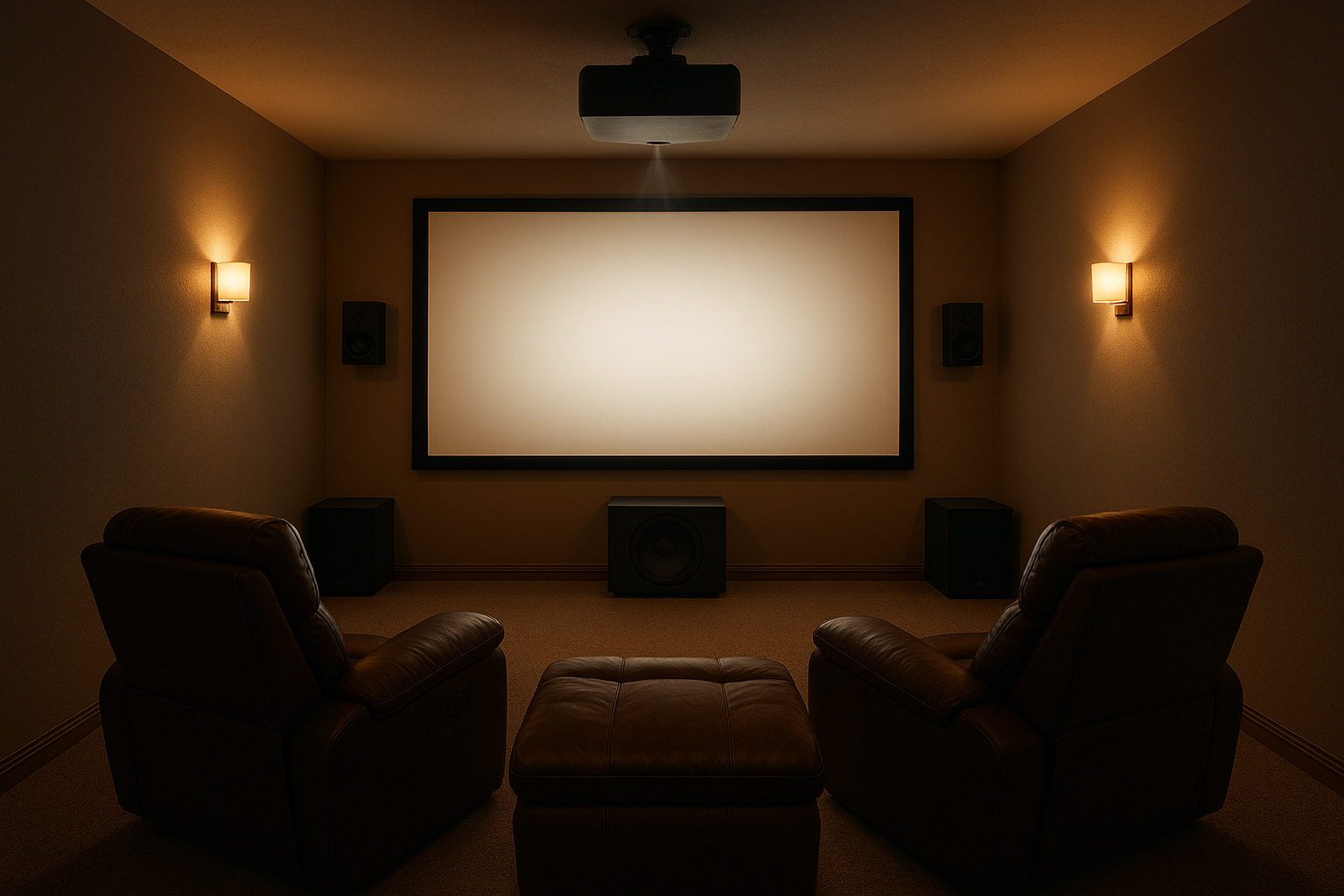
📌 Example: A cozy room layout with projector, recliners, surround speakers, sub woofer, and dim lights.

2. What are the Minimum Requirements for a Home Theater?
Bare essentials include:
- Projector (or large 75+ inch TV if projector not possible)
- Screen (fixed frame or motorized)
- Amplifier (for surround decoding)
- Main speakers, surround speakers, sub woofer
- Recliners or comfortable seats
- Acoustic panels & bass traps for sound clarity
- Lighting control

3. What is the Ideal Room Size for a Home Theater?
Room shape matters more than size. A rectangular room is best to avoid sound reflection issues.
- For example: 27 ft length × 14 ft width is perfect for a 120–150 inch screen with a 7.2 system.
- Avoid square rooms (sound bounces too much).
📌 Diagram Idea: Floor plan showing rectangular room vs square room.
4. Should I Go for a Projector or a Big TV?
- Projector: Ideal for a cinematic “big screen” feel (120+ inches). Works best in dark rooms.
- Big TV (OLED/LED): Easier to install, no need for dark environment, sharper for casual viewing. But limited in size.
📌 Diagram Idea: Split-screen comparison of TV vs projector setup.

5. What is Dolby Digital and THX?
- Dolby Digital: A multi-channel audio format delivering surround sound (5.1, 7.1, Atmos).
- THX: A certification ensuring cinema-grade sound quality (standardized for theaters).
📌 Diagram Idea: Dolby Digital speaker layout vs THX-certified theater icon.
6. How Many Speakers Do I Need?
- 1 Setup → Front L/R, Center, Surround L/R, Sub woofer.
- 2 Setup → Same as above + 2 extra rear speakers + 2 sub woofers.
- Dolby Atmos → Adds ceiling or upward-firing speakers for 3D sound.
📌 Diagram : Speaker layout diagrams (5.1 vs 7.2 vs Atmos).

7. Where Should I Place the Speakers?
- Front L/R: At ear level, angled toward the listener.
- Center: Just above/below the screen for dialogues.
- Surrounds: Slightly behind and to the side of the recliners.
- Sub woofer: Corners or along the front wall for maximum bass impact.
📌 Diagram Idea: Room with speaker positions marked.
8. Do I Need Acoustic Treatment?
Yes! Without treatment, sound bounces and becomes muddy.
- Acoustic Panels: Absorb mid-high frequencies.
- Bass Traps: Reduce low-frequency boominess.
- Diffusers: Scatter sound for balance.
📌 Diagram Idea: Wall showing panels, bass traps in corners.


9. How Much Does a DIY Home Theater Cost?
- Budget DIY: ₹1–2 lakhs (using value-for-money gadgets).
- Mid-range: ₹3–5 lakhs (good projector, recliners, Atmos).
- High-end: ₹10–15 lakhs (luxury brands, full THX setup).
10. What Kind of Recliners or Seating is Best?
📌 Diagram Idea: A pyramid chart showing budget vs performance tiers.
- Recliner seats with cup holders = premium theater vibe.
- Sofas or cushioned chairs = budget-friendly option.
- Ensure seats are at least 10–12 ft away from the screen (for 120 inch screen).
📌 Diagram Idea: Recliner row illustration with spacing marked.
11. How Important is Lighting?
Lighting sets the mood:
- Dimmable LEDs = control brightness.
- Smart RGB lights = match movie mood.
- Avoid overhead tube lights (cause screen glare).
📌 Diagram Idea: Room with LED strips on ceiling/floor.
12. Do I Need an Amplifier?
Yes. An AV Receiver (Amplifier) is the heart of the system.
- Decodes Dolby Digital/THX audio.
- Powers all surround speakers.
- Connects projector, speakers, and sub woofer together.
📌 Diagram Idea: Amplifier hub connecting projector + speakers.
13. Can I Use a Normal Living Room?
Yes, but a dedicated theater room has advantages:
- Soundproofing = less disturbance.
- Better immersion.
- Living rooms may have windows, reflective surfaces, and furniture that distort sound.
📌 Diagram Idea: Living room vs dedicated theater comparison sketch.
14. How Do I Test My Home Theater?
- Use Dolby Atmos/THX demo clips (free online).
- Movie Tests:
- Gravity → Surround immersion.
- Blade Runner 2049 → Deep bass.
- Mad Max: Fury Road → Explosive effects.
- Life of Pi → Visual color/contrast.
📌 Diagram Idea: TV/projector screen with demo icons.
15. Why is a Home Theater Special for Movie Lovers?
Because it transforms your home into a private multiplex.
- You control the sound, lighting, and comfort.
- Movie nights become a family/friends ritual.
- You relive cinema magic daily without queues or overpriced tickets.
📌 Diagram Idea: Family sitting on recliners with popcorn watching a giant screen.
The Project Journey…
I started building the home theater in phases. From acoustic wall treatments, to selecting surround speakers, to wiring amplifiers – each step taught me something new.
It wasn’t just about setting up gadgets, it was about creating a space where emotions, technology, and creativity blend.
My terrace was chosen as the ideal spot. With 27 ft length and 14 ft width, the proportions were perfect for a dedicated home theater setup.
—
Bare Minimum Requirements for a Personal Home Theater:
– Projector (Full HD/4K recommended)
– Big screen (minimum 120 inches for room size 27 ft x 14 ft)
– Amplifier (Dolby Digital / THX compatible)
– Surround speakers (5.1 or 7.2 setup)
– Main speakers and woofers
– Subwoofer (for bass impact)
– Recliners (for seating comfort)
– Air conditioner (to keep the environment cozy)
– Acoustic panels & bass traps (for sound treatment)
– Smart lighting (dimmable LEDs for theater vibe)
—
Comparison: TV Based vs Dedicated Screen Based Home Theaters
1. **TV Based Setup:**
– Pros: Easy to install, cheaper, works for small rooms.
– Cons: Limited screen size, less immersive, lacks true cinematic feel.
2. **Dedicated Screen + Projector Setup:**
– Pros: True big screen experience, immersive Dolby Digital surround, customizable.
– Cons: Requires more space, higher initial setup effort.
—
Testing Recommendations:
– For **bass and subwoofer**: Try the opening scene of *Edge of Tomorrow* or *Blade Runner 2049*.
– For **surround sound**: *Gravity* and *Mad Max: Fury Road* are unbeatable.
– For **clarity of dialogue**: *The Dark Knight* interrogation scene.
– For **visuals and screen quality**: *Life of Pi* and *Avatar*.
You can also use Dolby Atmos and THX demo trailers (available online) for calibration.
—
Acknowledgments
This journey would not have been possible without the blessings of my parents, the constant support of my family, and the encouragement of my childhood friends – Koushik Das (Titu), Somthirta (Deep) – who always cheered me on.
Special thanks to my audio forum companions – Papu Da from Durgapur, Soumen Jana from Howrah, and many others who guided me directly and indirectly through endless discussions, debates, and laughter.
—
Closing Thoughts
A DIY home theater is not just about gadgets. It’s about the feeling of creating something with your own hands, of sitting back on a recliner, dimming the lights, pressing play, and hearing the world around you transform into a story.
When friends and family visit and gasp, “Wow, this feels better than the multiplex!”, that’s when you know every hour of soldering, wiring, and testing was worth it.
So to every movie lover, dreamer, and DIY enthusiast reading this – remember, you don’t need lakhs of rupees to live your cinematic dream. All you need is passion, patience, and the will to create. Because dreams always look best on the big screen.